Gold Plating For Exceptional Corrosion Resistance & Excellent Conductivity
What Is Gold Plating?
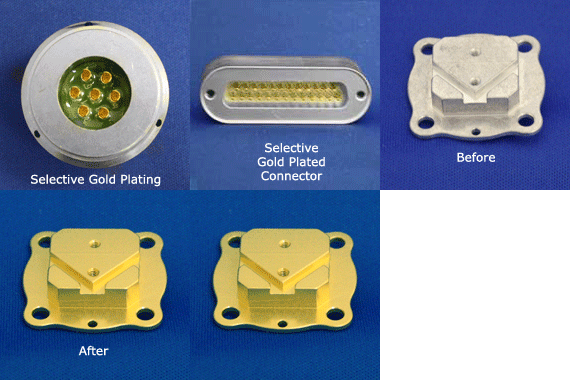
Gold plating is the process of electrolytically depositing a layer of gold onto a part. Plated gold deposits can range in color from yellow to orange and be bright or dull (matte) in appearance.
Exceptional Corrosion Resistance / Excellent Conductivity
Engineers and manufacturers often use gold plating because of its exceptional resistance to corrosion. Gold plating also has low contact and electrical resistance making it ideal for electronic applications. Many electronic parts, such as connectors or circuit board components, are gold plated to provide maximum corrosion resistance while maintaining excellent conductivity and solderability.
Gold Plating Specifications
MIL-G-45204 and ASTM B 488 are the prime gold plating specifications. They define three types of gold deposits produced by electroplating. Types I, II, and III refer to purity while grades A,B,C,D refer to Knoop hardness.
Gold - MIL-G-45204 / Types I, II, III
ASTM B 488 / Types I, II, III
- Type I: 99.7% gold
- Type II: 99.0% gold
- Type III: 99.9% gold
Gold - MIL-G-45204 / Grades A,B,C,D
ASTM B 488 / Grades A,B,C,D
- Grade A: Hardness range of 90 or less Knoop
- Grade B: Hardness range from 91 to 129 Knoop
- Grade C: Hardness range from 130 to 200 Knoop
- Grade D: Hardness range of 201 or more Knoop
The most common alloying elements in Types I and II are nickel and cobalt.
Gold Plating Over Copper Or Silver Substrates
In many gold-plating applications where the substrate is made of copper or silver, a barrier layer of nickel is applied between the substrate and the gold to prevent the copper or silver ions from diffusing into the gold layer.
Soft Pure Gold For The SemiConductor Industry
Type III gold (99.9% gold is usually referred to as "pure") is used in the semiconductor industry when parts need to be wire bonded during fabrication.
Gold Types For The Electronic Industry
The Type 1 and Type II gold deposits are harder and are alloyed with either cobalt or nickel as deposited. These alloys have a much higher hardness and are more appropriate for contacts and connectors.
About Hi-Tech Plating
Hi-Tech Plating will work with you to ensure that the right type of gold plating is selected for your application. Hi-Tech Plating provides gold plating in accordance with MIL-G-45204 and ASTM B 488 for Types I, II, and III.
Put Our Expertise To Work For You
Contact Hi-Tech Plating today and put our expertise to work for you today.